
Sitting Too Much at Work – How to Add More Movement to Your Working Day
Meeting. Computer. Lunch. Computer. Meeting. Computer.
For many people, a typical working day is also a very sedentary one.
It's easy to think that the solution is simply to exercise before or after work. But the working day lasts for many hours, and there is also value in creating natural breaks from sitting during the day itself.
That doesn't have to mean workout clothes, an office gym or an hour of group exercise.
It can start with just a few minutes.
Why should we break up prolonged sitting?
Modern offices are designed to let us do almost everything from the same place.
We work at our computers. Meetings take place online. Questions for colleagues are sent via Teams or Slack. Food can even be delivered to the door.
Efficient? Absolutely.
But it also means that many of the natural reasons to get up and move have disappeared.
That's why it's useful to think not only about exercise, but about movement throughout the working day.
It's about the small things:
Standing up.
Walking.
Changing position.
Taking the stairs.
Walking over to a colleague instead of sending a message.
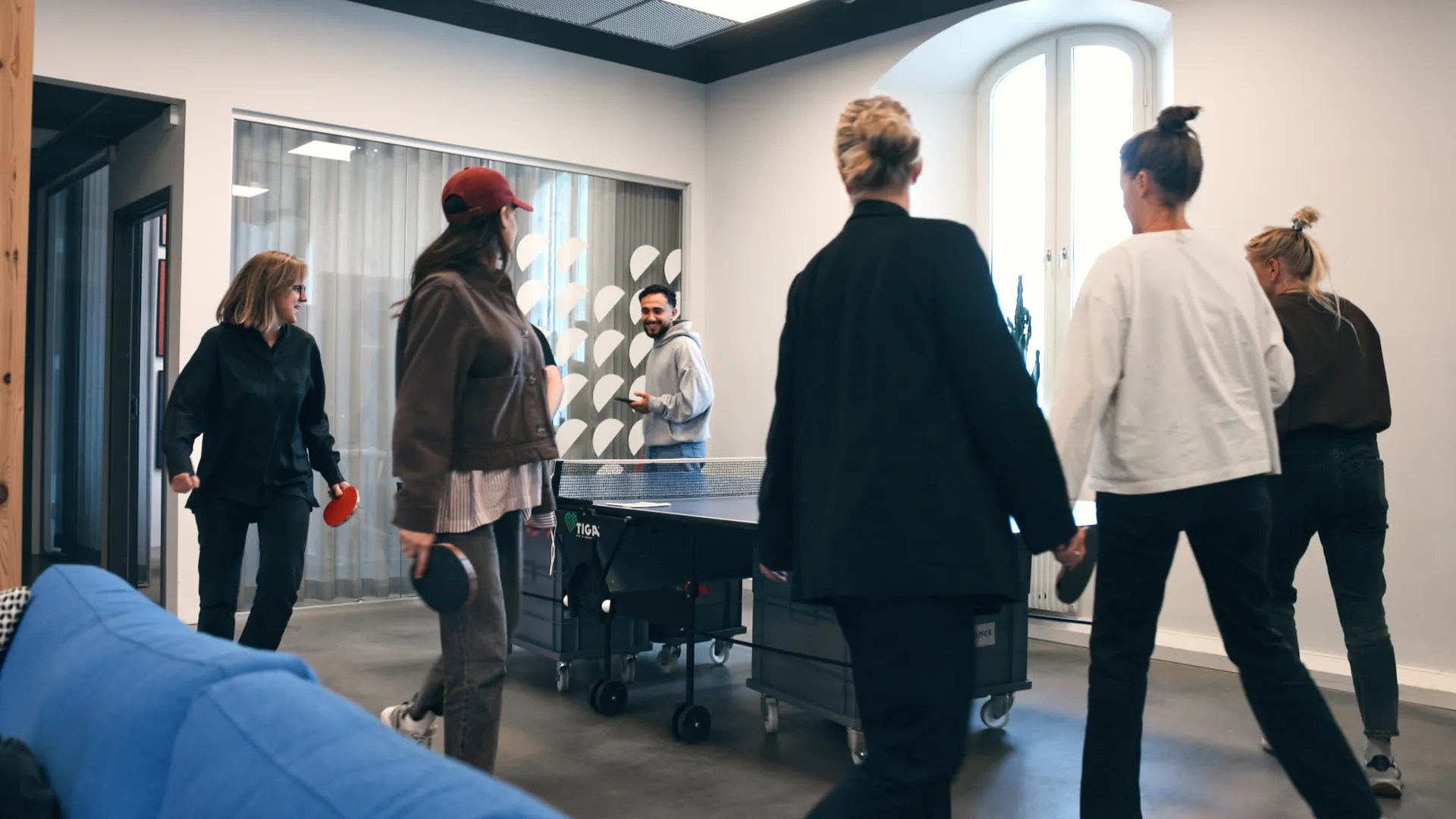
Or playing a few minutes of table tennis.
Movement doesn't have to mean exercise
When companies want to invest in employee health and wellbeing, it's easy to think big.
Group workouts. Step challenges. Gym memberships. Races and other major initiatives.
All of those things can be great.
But there's also a much simpler question to ask:
How can we make moving a little more during an ordinary working day feel natural?
The physical workplace can play an important role.
A coffee machine gives you a reason to walk somewhere. A staircase creates movement between floors. A table tennis table can give you a reason to leave your desk together with a few colleagues.
These are small things.
And that's precisely why they can be relatively easy to make part of everyday life.
7 simple ways to add more movement at work
1. Introduce active breaks
Choose one or two times when it's natural to leave the desk for a few minutes.
It doesn't need to be organised exercise. A short walk, a few minutes of table tennis or simply going outside for some fresh air can create a useful break in the day.
2. Have walking meetings
Not every meeting requires a screen.
If two or three of you need to talk rather than look at a presentation, try having the meeting while walking.
3. Make the stairs the easy choice
If your workplace has several floors, small changes to the environment can influence behaviour. Make the stairs easy to find and pleasant to use.
4. Create reasons to leave the desk
Not everything needs to be within arm's reach.
Shared spaces can serve a social purpose while also encouraging people to move around the workplace.
5. Use the table tennis table
Already have a table? Make sure people actually use it.
One simple approach is to set fixed playing times. At Wilson Creative, for example, we play round-the-table at 10 am and 3 pm every working day.
When everyone knows the time, nobody has to organise the activity from scratch. Anyone who wants to join simply heads to the table.
6. Create a shared challenge
A little friendly competition can make participation more fun.
It could involve table tennis, walking or other activities. Departments could challenge one another, or the whole company could work towards a shared goal.
7. Keep it voluntary and fun
Perhaps most importantly, people have different circumstances and different relationships with physical activity.
An employer doesn't need to force employees to exercise.
Instead, create opportunities that are easy to say yes to.
Why table tennis?
We're obviously biased.
But table tennis has several practical qualities that make it particularly interesting in a workplace.
You don't need to change clothes. A game can be very short. Different formats allow anything from two people to a larger group to participate. And, perhaps most importantly, there's a clear social element.
You rarely go to the table tennis table alone.
That means a break from the desk can also become an opportunity to connect with colleagues.
From wellbeing initiative to everyday habit
A wellbeing week can create energy.
A competition can create engagement.
But the really interesting part is when movement becomes a natural part of the working day even when no particular campaign is taking place.
That's why we believe in small, recurring activities.
Ten minutes that actually happen can be more valuable as a habit than an ambitious activity that takes place once a year.
The same applies to table tennis.
A table is just a table until people start gathering around it.
Already have a table tennis table at work? Create your company on pingis.work and give your colleagues a reason to start using it.
